
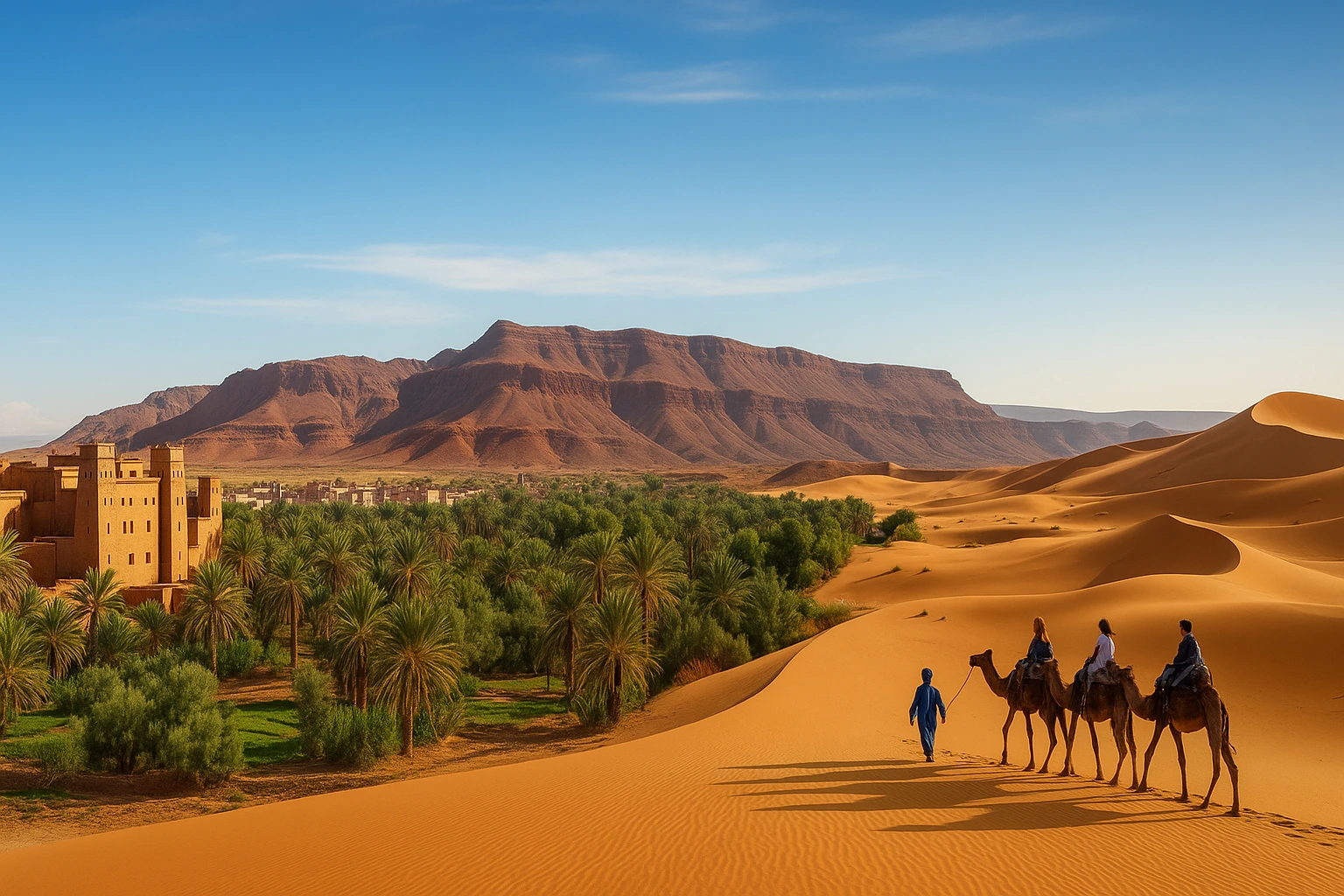
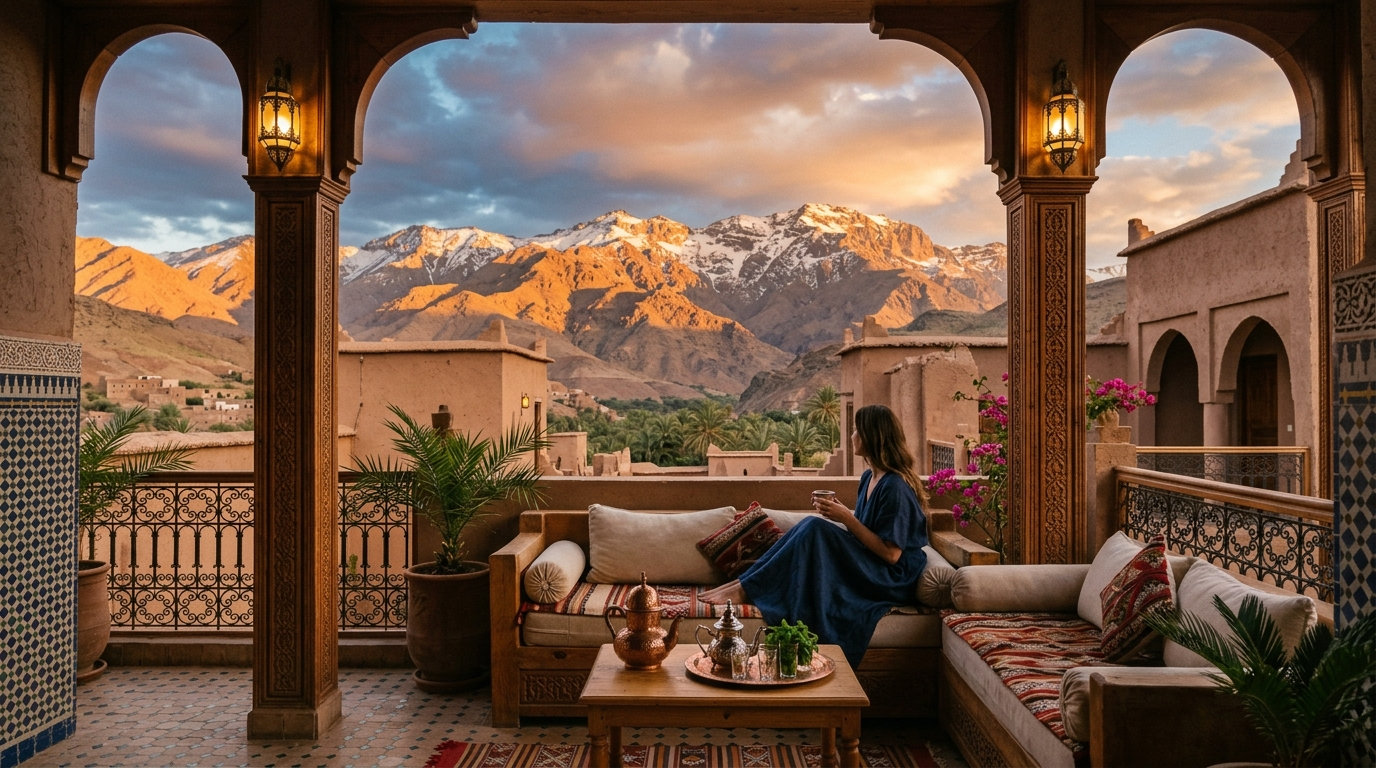
The Sahara is never quite the same twice.
Morning arrives quietly, revealing dunes reshaped by the wind overnight. By late afternoon, the light softens and the landscape turns from pale gold to deep ochre. After sunset, the temperature falls, the horizon disappears and silence becomes part of the experience.
Choosing the best time to visit the Sahara Desert in Morocco is therefore about more than avoiding extreme temperatures. The season shapes how you travel, how long you spend outdoors and how naturally the desert fits into the rest of your Moroccan journey.
For most travellers, spring and autumn offer the most comfortable conditions for a private Sahara journey, particularly when the desert is combined with Marrakech, the Atlas Mountains and southern Morocco.
But each season has its own character.
When Is the Best Time to Visit the Sahara Desert?
For most private journeys, the strongest periods are:
March to May
and
September to November
Spring and autumn generally provide a more comfortable balance between daytime warmth and cooler evenings, while also working beautifully for journeys that include Marrakech, the Atlas Mountains and the valleys of southern Morocco.
The important point is to plan for the entire route, not simply the nights spent among the dunes.
A Sahara journey often begins several days earlier, as the landscape gradually changes from city to mountain, valley, kasbah and finally desert.
That transition deserves as much consideration as the destination itself.
Spring in the Sahara: March to May
Spring is one of the most rewarding times to travel south.
Days are generally better suited to exploring outdoors than during the height of summer, while evenings invite time around camp rather than an immediate retreat indoors.
The wider journey can also be particularly beautiful.
Leaving Marrakech, the road rises towards the High Atlas before descending into southern landscapes of palms, earthen villages and increasingly open horizons.
By the time the dunes appear, the desert feels like the natural conclusion to several days of changing scenery.
Why choose spring?
Spring is particularly well suited to travellers who want to combine the Sahara with:
- Marrakech
- The High Atlas
- Ouarzazate
- Skoura
- The Draa Valley
- Merzouga
- Fès
It also provides greater flexibility for photography, walking and outdoor experiences.
Rather than structuring the entire day around the heat, there is more freedom to let the desert set the pace.
The feeling
Warm days.
Longer light.
Clear horizons.
Evenings outside.
For a first private Sahara journey, spring is often an excellent place to begin.
Autumn in the Sahara: September to November
Autumn brings another particularly attractive window for desert travel.
After the intensity of summer, the south gradually becomes easier to experience at a slower pace.
September can still be warm, particularly early in the month, while October and November often lend themselves beautifully to private itineraries through southern Morocco.
Why choose autumn?
Autumn works particularly well for:
- Couples
- Honeymoons
- Photography
- Private desert stays
- Longer Morocco journeys
- Travellers combining Marrakech and Merzouga
- Families seeking a more comfortable desert experience
October, in particular, is often an attractive month to consider when designing a journey that combines cities, mountains and the Sahara.
The feeling
Softer light.
Long shadows.
Warm afternoons.
Evenings that encourage you to stay outside a little longer.
Autumn allows the Sahara to become part of the journey rather than something to endure between air-conditioned spaces.
Winter in the Sahara: December to February
Winter reveals a different desert.
Days can be beautifully clear and comfortable, while the light often has a crisp quality that photographers appreciate.
But there is one detail travellers sometimes underestimate:
the Sahara can be cold at night.
Once the sun disappears, temperatures can fall considerably.
This makes the choice of camp particularly important.
Warm bedding, thoughtful service and accommodation suited to the season matter far more than decorative touches.
Winter may suit you if:
- You prefer cooler daytime conditions
- You enjoy clear winter light
- You do not mind cold evenings
- You want to combine Marrakech with southern Morocco
- You prefer travelling outside the warmer spring and autumn periods
Pack accordingly and allow the season to remain part of the experience.
A cold desert evening beside a fire can be every bit as memorable as a warm autumn sunset.
Visiting the Sahara in Summer: June to August
Summer requires more careful consideration.
Southern Morocco can become intensely hot, particularly during the middle of the day.
That changes the rhythm of travel.
Activities may need to happen early in the morning or towards sunset.
Long periods outdoors become less comfortable.
The middle of the day is better left for rest.
And road journeys require thoughtful planning.
For travellers whose primary reason for visiting Morocco is the Sahara, we would generally favour spring or autumn where dates allow.
If summer travel is unavoidable, the itinerary can be adapted.
More time might be given to the Atlantic coast or higher-altitude landscapes, while the desert portion is structured carefully around the conditions.
Luxury travel is not about ignoring the season.
It is about designing around it.
Merzouga and Erg Chebbi
For many travellers, the Sahara they imagine is Merzouga.
On the edge of the Erg Chebbi dunes in eastern Morocco, Merzouga provides access to the sweeping sand landscapes that have become synonymous with the Moroccan Sahara.
But arriving at Merzouga should not be treated as the beginning of the experience.
The journey towards it matters.
From Marrakech, the route can cross the High Atlas and continue through Ouarzazate, Skoura and southern valleys before reaching the desert.
From Fès, the landscape changes differently as the journey moves south through the Middle Atlas and towards eastern Morocco.
Both approaches can be extraordinary.
The right one depends on what comes before and after.
Merzouga or Zagora?
The two are often grouped together under the phrase “Morocco desert tour”, but they offer different experiences.
Merzouga
Merzouga is the choice for travellers seeking the great dune landscapes associated with Erg Chebbi.
It requires more travel time from Marrakech, but that distance can be used intelligently to create a journey through the Atlas and southern Morocco.
For a first Sahara experience where dunes are a priority, Merzouga is often the stronger choice.
Zagora
Zagora belongs to the landscapes of the Draa Valley and Morocco's deep south.
The environment is more arid and rocky, with a different relationship to the surrounding valleys and settlements.
It can make sense within particular routes, especially when time is more limited.
Neither should simply be selected because it appears closer on a map.
The decision should depend on what you want from the desert.
And What About Agafay?
Agafay is convenient, beautiful and close to Marrakech.
But it is not the Sahara.
Its landscape is rocky and arid rather than composed of the great Saharan dunes found around Merzouga.
For travellers spending only a few days in Marrakech, an afternoon and evening in Agafay can provide a welcome change of atmosphere.
You might leave the city after lunch, watch the light fall across the landscape, have dinner and return to Marrakech that evening.
But if standing among sweeping dunes is central to how you imagine Morocco, make time for the journey south.
Setting the right expectation is part of good travel design.
How Many Nights Should You Spend in the Sahara?
This decision can completely change the experience.
One Night
One night usually follows a familiar rhythm:
Arrival.
Sunset.
Dinner.
Sleep.
Sunrise.
Breakfast.
Departure.
It can work when time is limited.
But it passes quickly.
Two Nights
Two nights create an entirely different relationship with the desert.
On the second morning, you are not packing immediately after breakfast.
There is time to explore.
Time for a long lunch.
Time to return to camp.
Time to read.
Time to walk.
And when the second sunset arrives, you are no longer seeing the landscape for the first time.
You begin to notice it.
For a private luxury journey to Merzouga, two nights are often worth considering when the wider itinerary allows.
Choosing a Luxury Desert Camp
The word luxury is used very freely in the desert.
A beautifully photographed tent does not necessarily create a refined experience.
What matters more is how the camp relates to its surroundings.
Location
A desert camp should provide a genuine sense of landscape.
Consider how close neighbouring camps are and how much visual and acoustic privacy remains.
Privacy
Tents should be positioned thoughtfully.
There should be places where you can experience the desert away from common areas.
Comfort
Good bedding, appropriate seasonal arrangements and well-designed private facilities matter.
Service
Attentive, warm and discreet.
The desert does not need constant entertainment.
Food
Meals should feel generous and considered while remaining appropriate to the setting.
Atmosphere
This may matter most.
After dinner, can the camp become quiet?
Can you walk a short distance away and feel the scale of the desert?
Luxury in the Sahara is often defined by what has deliberately been left out.
Sunrise and Sunset in the Sahara
Both deserve space in the itinerary.
Sunset is often the first moment travellers truly understand the scale of the dunes.
As the sun lowers, shadows lengthen and the sand changes colour almost by the minute.
Do not schedule dinner so early that you need to leave before the light has finished.
Sunrise is quieter.
The air is cooler.
The camp may still be sleeping.
Walking onto the dunes before breakfast can feel more private than anything arranged during the day.
Neither needs to become an elaborate activity.
The landscape is enough.
Do You Need to Ride a Camel?
No.
A short dromedary ride is part of how many travellers imagine the Sahara, and it can certainly form part of the experience.
But it is not compulsory.
You might prefer to:
- Walk through the dunes
- Explore privately by 4x4
- Spend time photographing the landscape
- Visit surrounding areas
- Remain at camp
- Do very little at all
A tailor-made journey should not include something simply because every other desert itinerary includes it.
The experience should reflect the traveller.
What to Wear in the Sahara
Desert packing is about layers.
Even when the day is warm, conditions can change after sunset.
Consider bringing:
- Lightweight daytime clothing
- Comfortable closed shoes
- Sunglasses
- A hat
- Sun protection
- A scarf or light wrap
- A warmer evening layer
- Lip balm
- Personal medication
- A small day bag
For winter journeys, warmer clothing for evenings and early mornings becomes particularly important.
Your Travel Designer should advise according to the actual season of your journey rather than giving you one generic desert packing list.
The Journey From Marrakech to the Sahara
One of the biggest mistakes travellers make is thinking of Marrakech to Merzouga as a simple transfer.
It is not.
The distance is considerable, and trying to complete it too quickly can turn what should be one of Morocco's most rewarding routes into a long day inside a vehicle.
Instead, allow the journey to unfold.
A thoughtfully designed route might be:
Marrakech → High Atlas → Ouarzazate → Skoura → Draa Valley → Sahara
Stay along the way.
Walk.
Have lunch.
Experience the changing architecture.
Watch the landscape gradually become more open.
Then, when the dunes finally appear, they feel earned rather than inserted into an itinerary.
Travelling From Fès to Merzouga
Fès offers another natural approach to the desert.
The journey south passes through very different landscapes before reaching eastern Morocco and Merzouga.
This creates the possibility of a beautifully structured itinerary:
Fès → Middle Atlas → Merzouga → Southern Morocco → Marrakech
Rather than returning along the same route, the journey continues.
That creates progression.
And progression is one of the things that makes an itinerary feel composed rather than assembled.
The Sahara for Honeymoons
The desert can be one of the most intimate parts of a honeymoon in Morocco.
But it does not require elaborate romantic staging.
Privacy is enough.
A carefully selected camp.
Dinner beneath an open sky.
A walk beyond the lights.
A morning without an alarm.
For honeymooners, we often prefer placing the Sahara towards the middle or later part of the journey.
It gives the itinerary somewhere to build towards.
Visiting the Sahara With Children
Families can experience the Sahara beautifully when the journey is designed around them.
Children often respond naturally to the landscape.
The scale.
The sand.
The journey.
The sense of being somewhere completely different.
But long road days need to be broken intelligently.
Departure times should remain flexible.
Accommodation should suit the family's needs.
And the desert should not become an exhausting sequence of organised activities.
Private transport makes an enormous difference because the journey can respond to the family rather than a timetable.
Photography in the Sahara
If photography matters to you, protect the edges of the day.
Midday light can flatten the dunes.
Early morning and late afternoon reveal their shape.
Long shadows create depth.
Wind can redraw the surface of the sand overnight.
Do not fill sunrise and sunset with unnecessary arrangements.
Be in the right place.
Then wait.
A Private Sahara Journey: An Example
A refined desert journey from Marrakech might unfold over several days.
Day 1 — Marrakech to the Atlas & Southern Morocco
Leave the city after breakfast.
Cross the High Atlas privately.
Stop when the landscape invites it.
Continue towards southern Morocco for the night.
Day 2 — Skoura & the Draa Landscapes
Spend time among palm groves and earthen architecture.
Avoid rushing onwards.
Stay a second night in the south if the itinerary allows.
Day 3 — Towards Merzouga
Continue as the landscape becomes increasingly open.
Arrive at the dunes before sunset.
Settle into camp.
Day 4 — Sahara
Wake without needing to leave.
Explore if you wish.
Rest if you do not.
Watch the desert change throughout the day.
Day 5 — Continue the Journey
Rather than racing directly back to Marrakech, continue according to the wider itinerary.
Perhaps towards Fès.
Perhaps back through southern Morocco.
The desert should belong to the journey — not interrupt it.
So, When Should You Go?
For most travellers:
March to May
Excellent
Particularly suitable for a wider journey combining Marrakech, mountains and desert.
June to August
More demanding
Possible, but requires careful planning around the heat.
September to November
Excellent
One of the strongest periods for a private Sahara journey.
December to February
Beautiful, but cooler
Clear days can be lovely; prepare for colder nights.
If you want the simplest recommendation:
Choose spring or autumn for your first private Sahara journey.
Then design the rest of Morocco around those dates.
Designing the Sahara Around You
The best desert journey is not defined by the number of activities included.
It is defined by rhythm.
When you arrive.
How long you stay.
Where you sleep.
Whether you wake for sunrise.
Whether you spend the afternoon exploring or reading outside your tent.
Whether the road to the desert is treated as an inconvenience or as part of Morocco itself.
At Caprice Morocco, every Sahara journey can be shaped around the traveller — from the route and private transport to accommodation, pacing and the experiences that genuinely belong.
Begin Your Private Sahara Journey
Tell us when you are considering Morocco and what draws you towards the desert.
Speak with a Travel Designer to create a private Sahara journey shaped around your dates, pace and preferred way of travelling.
Frequently Asked Questions
What is the best time to visit the Sahara Desert in Morocco?
For most travellers, spring and autumn offer the most comfortable balance for a Sahara journey, particularly when combined with Marrakech, the Atlas Mountains and southern Morocco.
What is the best month to visit Merzouga?
There is no single best month, but April, October and other periods within spring and autumn are often attractive starting points when planning a private journey. Actual conditions should always be considered closer to departure.
Is the Sahara cold at night?
It can be, particularly during winter. Temperatures can fall considerably after sunset, making appropriate clothing and well-chosen accommodation important.
How many nights should I stay in Merzouga?
One night can work when time is limited. Two nights provide a slower experience and allow you to spend a full day in the desert without arriving and departing almost immediately.
Is Agafay the Sahara Desert?
No. Agafay is a rocky, arid landscape close to Marrakech. It offers a beautiful escape from the city but is different from the Saharan dune landscapes around Merzouga.
Is Merzouga worth the journey from Marrakech?
For travellers who genuinely want to experience the great dunes of the Moroccan Sahara, yes — provided the route is given enough time. The journey is best broken through the Atlas and southern Morocco rather than treated as a rushed return excursion.
Can Caprice arrange a private luxury desert journey?
Yes. Caprice can design a tailor-made Sahara journey including private transport, selected desert accommodation, guiding and experiences, integrated into a wider Morocco itinerary.

